
x402 Is More Than Agent Payments
x402 is becoming the discovery layer for the agent economy, the place agents find services and providers get found and paid in the same call.

x402 is becoming the discovery layer for the agent economy, the place agents find services and providers get found and paid in the same call.
Before search, demand on the internet flowed through brands people already knew. You typed a URL, opened a directory, or went where a banner sent you. Then search changed the interface. People stopped navigating to vendors and started describing what they wanted, and a machine decided which provider to put in front of them. Search was an entirely new distribution channel, with a new buyer interface and a new gatekeeper.
When Google opened AdWords in October 2000, it had about 350 advertisers, and the pay-per-click auction arrived in 2002. The companies that moved early bought the highest-intent demand in marketing for pennies, because almost no one was bidding against them. They claimed keywords, learned what ranked, and accumulated position while the channel was still cheap and uncrowded. Selection became the whole game. Whoever the engine chose captured the customer, and the providers who learned to be chosen built advantages that lasted. By the time the rest of the market understood what had happened, search became the most competitive auction in advertising, and latecomers paid many times more for the same click. One of the clearest winners was Booking.com, which leaned into paid search early and became one of Google's largest advertisers and best in class at search engine marketing, making it difficult for competitors to keep up. The travel companies that relied on free organic traffic instead, like TripAdvisor, were later disintermediated when Google reshaped the results page. The early advantage was claiming a position in a new discovery layer while it was still forming.
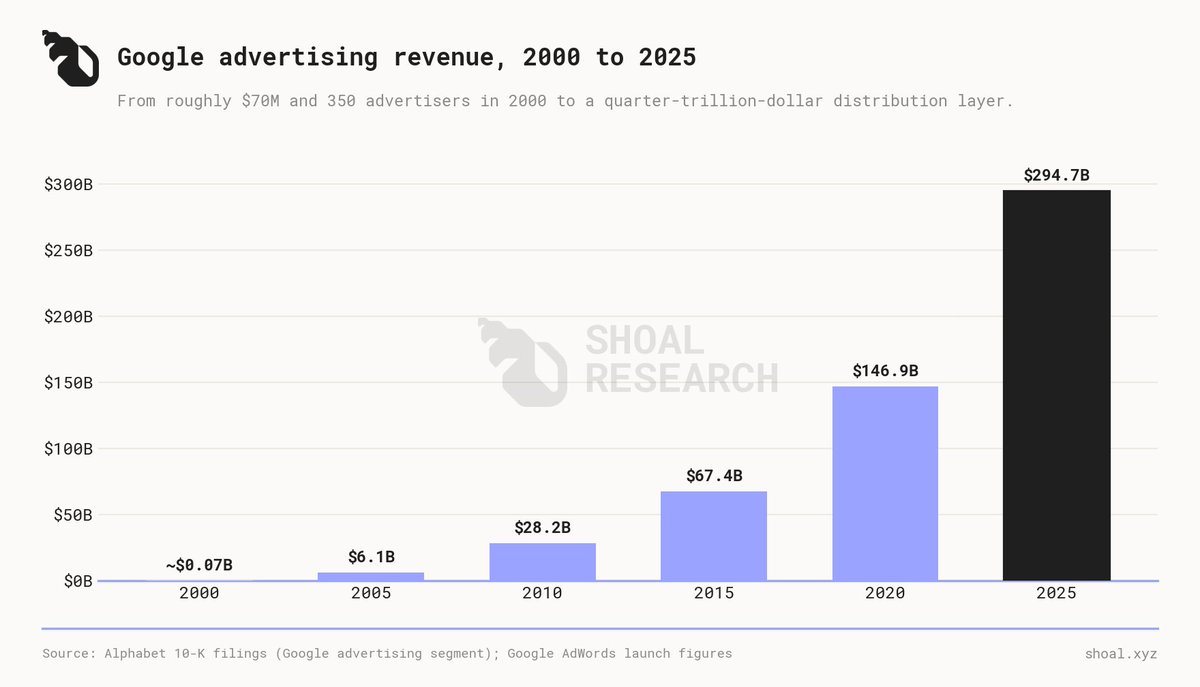
x402 is a similar shift for agents, which are becoming the buyer interface the way search once became the buyer interface. The human stops browsing vendors, comparing landing pages, and choosing between SaaS products, and the agent selects the service instead. X402 and machine payment protocols turn paid API calls into the selection event inside that new channel, with one difference that makes it sharper than search. With search, the click was the start of a funnel. With x402, the moment the agent discovers a service can also be the moment it pays. The discovery and the conversion are the same event.
At its core x402 is becoming the discovery layer for the agent economy, the place where agents find the services they need and where providers get found and paid in the same call. The payment is the visible part, and the discovery is the nascent opportunity. For a provider, the value shows up as distribution, demand that arrives intent-attached and only when an agent actually calls. Whereas agents, cab discover and find the right service and pay for it in one step. Teams onboarding onto x402 should expect the first-order value to show up as distribution before it shows up as massive revenue.
This argument is framed for content providers, data providers, and anyone offering a service on the open internet, the supply side that can list on the rail and get discovered. Infrastructure providers like AWS and Cloudflare sit at a different layer with a different agenda and ontology, since they own the edge where traffic is gated and priced. That layer, along with the content gating and attribution questions that come with it, is the subject of a separate paper. The focus here stays on discovery for the providers building on top of the rail.
Right now, most paid API endpoints are not large businesses, shown in the public x402scan data. Even when the network shows millions of transactions and more than a million dollars of aggregate volume, the visible services at the top of the leaderboard are often doing low thousands of dollars in monthly volume. Most individual providers do not have a standalone revenue line large enough to matter given the scale of some of the providers currently supported like Exa who raised $85M (@ExaAILabs )to build the search engine for AI and support x402 payments. At an event we attended, Exa's co-founder Jeff said he has long been a fan of crypto and sees this as the natural direction for the agentic economy and for agents. We are paraphrasing, but the framing is worth noting, because it comes from an AI search founder rather than from anyone native to crypto.
For a service provider, the paid x402 call is closer to a completed ad click which is a unit of demand, routed by an agent, attached to intent, settled at the moment of use, and observable onchain. The provider charges for an API call, but the strategic value is distribution inside the place agents go to buy capabilities.
The provider's mental model should shift from "I am enabling micropayments" to "I am getting listed in the place agents go to buy services."
Hypothetically, If a provider charges $0.50 for a call that costs $0.001 to serve, the spread looks irrational under cloud infrastructure logic, but under marketing logic it can make sense because the provider is monetizing usage while also buying distribution, intent capture, routing eligibility, and conversion inside an agent workflow.
x402 lets agents pay APIs, but that framing undersells what is happening. x402 and MPP create a machine-readable marketplace where agents discover services and providers compete to be found and paid, with the payment functioning like the tracking pixel. The paid call is similar to a Stripe checkout but at this stage functions more like a Google Ads click with settlement attached, which is the start of an agent-native distribution market.
Everyone is staring at x402 volume and asking how much money is moving, but the better question is who decides which service the agent calls, because once agents become the buyer interface, the user no longer browses vendors, compares landing pages, signs up, enters an API key, or chooses between SaaS products. The agent chooses, which turns service discovery into the new control point.
The Call Is the Conversion Event
Traditional software marketing has a long funnel:
- A user sees an ad
- The user clicks
- The user visits a landing page
- The user signs up
- The user gets an API key
- The user integrates the product
- The user eventually pays
Agent commerce compresses that entire path. The agent finds a service and pays for it in the same motion it gets the result, and the long human funnel above collapses into that one exchange.
That makes the x402 payment event unusually dense. It is a transaction and a signal that an agent had intent and selected a provider at the moment of need.
For providers, the first wave of agent-commerce adoption will probably look small if measured only by provider revenue. A few thousand dollars of monthly endpoint volume will not move the needle for most SaaS companies or API providers, but a few thousand dollars of paid calls can still answer strategic questions that normal marketing cannot answer cleanly:
- Which agents are calling us?
- Which wallets return repeatedly?
- Which adjacent services do the same wallets use?
That is marketing data carried through a payment event.
x402 Turns API Pricing Into Marketing Spend
This is the same reason companies pay Google for search ads, Amazon for marketplace placement, Apple for App Store distribution, and affiliate networks for attributed conversions. The real value is being present at the moment demand forms, which is why the direct revenue from the first interaction should be seen as secondary.
x402 has the potential to become the agent-native version of that pattern, because the provider can receive demand without a human visiting a website, creating an account, going through procurement, taking a sales call, or managing an API-key workflow. The agent can call the service at the exact moment the service is needed.
That is a powerful distribution surface even before payment volume becomes large, although it also makes providers more substitutable. If an agent can reach any comparable API through the same payment flow, then the provider's advantage shifts from owning the user relationship to being selected by the router.
That means providers will need to optimize for agent selection the same way websites optimized for search selection, where machine-readable signals like price and reliability become the core agent SEO metrics.
x402 as Real Revenue
The distribution framing only works if there is a path from learning-curve revenue to meaningful revenue. How quickly that path forms decides how patient providers need to be.
One of the core benefits right now is the open discoverability, in addition to the payment primitive. An open standard lets an agent discover and combine services it never integrated with directly, and that composability is what lets a single agent assemble a workflow across many providers. The same openness happens to be auditable, which is a second benefit. On a closed rail a provider's usage numbers are whatever its own dashboard reports, and no outside party can verify them, while on x402 every call is a public on-chain payment that anyone can reconstruct by payer, time, and wallet. Coinbase, Circle, and the x402 Foundation built the rail in the open on purpose, and both the composability and the analysis in this piece exist only because they did. The same transparency that lets an operator inflate a leaderboard also lets anyone catch it.
For x402 to become a real revenue channel for the average serious SaaS provider rather than only the top one or two players, the service-market subset of the ecosystem needs to reach a scale not currently visible in the data. Growth trajectory is not validatable from a single snapshot, which means what is implied here rests on the assumption that the ecosystem continues to expand at recent rates, followed by a breakout use case.
Case Study: AWS Puts x402 Behind a Quarter of the Internet
On June 15, 2026, Coinbase and AWS turned on agent payments at the edge. Any site behind Amazon CloudFront and AWS WAF can now charge AI agents per request in USDC, settled through Coinbase's x402 Facilitator and configured from the existing AWS console with no new infrastructure. AWS describes CloudFront and WAF as the backbone for roughly a quarter of the internet, which means a quarter of the web can now treat an agent as a paying customer.
The flow is the performance-marketing pattern in production. An agent requests a resource, the edge returns an HTTP 402 with a machine-readable manifest that lists the price, the accepted networks, and the destination wallet, the agent pays, the Facilitator verifies the payment on-chain, and the content is served inside a single request. Base is the default rail because settlement lands in about 200 milliseconds for well under a cent, which is the cost shape that per-request pricing needs. AWS takes no cut, and funds settle straight to the publisher's wallet.
What matters for providers is legitimacy, reach, and the ability to capture agentic traffic, more than any single revenue number. Agents are already running free across the open web, collecting any open data or content they can reach without paying for it, and an on-chain rail is the first way to turn that traffic into something a provider can see and charge for. A hyperscaler wiring on-chain settlement into its content-delivery edge is the clearest signal yet that agent-paid access is becoming default infrastructure. AWS WAF Bot Control already classifies more than 650 agent types, including GPTBot, Claude-Web, and Perplexity-Bot, and lets a publisher price each tier differently, which turns agent traffic from a bandwidth cost into a priced, measurable demand channel. It builds on the Bedrock AgentCore Payments work from May, where Coinbase and Stripe wired x402 into the agent side, and both ends of the transaction now sit inside AWS. Coinbase also shipped the x402 Bazaar, an open searchable registry where agents discover x402 endpoints by price and capability, which is the discovery marketplace in production.
The case study is not a revenue story yet, because neither company has disclosed launch customers or early figures. The point is the new surface. Once a quarter of the internet can accept agent payments from a console toggle, the question for a provider stops being whether agents can pay and becomes whether the provider is discoverable and priced when they do. That is the performance-marketing question, now asked at the scale of the open web.
The Wallet Is the Bottleneck
The x402 endpoint solves discovery, but that is only half of a conversion, because discovery turns into revenue only if the agent can pay in the moment it asks.
Paying at the moment requires a provisioned and funded wallet. The agent needs USDC on an accepted chain, a key it can sign with, and enough balance to clear the price the 402 quotes, all ready at the instant of the call. If the agent, or the user behind it, cannot onboard and fund a wallet when it hits the endpoint, the 402 is a dead end. The provider got discovered and still did not get paid. Although sites might have the option to pay, we might see agents not wanting to pay and finding other sources.
That gap is the clearest near-term risk to the thesis. The supply side is getting solved quickly, since AWS, the facilitators, and the payment layers are removing the work of accepting agent payments. The demand side depends on every calling agent already carrying a funded wallet, which is not yet the default. Until wallet provisioning and funding are built into agent runtimes the way an API key is built into a script today, a real share of discovered demand will fail to convert because the buyer could not pay.
The fix is agent-side, and it is starting to appear. Bedrock AgentCore Payments (@awscloud) , AgentCash (@agentcashdev), SpongePay @paysponge), LocusPay (@PayWithLocus), Visa CLI (@Visa), Coinbase CLI (@coinbase), and Circle agent (@BuildOnCircle), to name a few, provision and fund a wallet inside the agent loop, and payment layers can hold the wallet on the agent's behalf. The dominant answer is that crypto would likely have to be completely abstracted from the experience and stripe already offers this. None of these is universal yet, which is why wallet readiness across the agent population is the variable that caps how much x402 discoverability turns into revenue, more than endpoint availability.
The Aggregator Could Capture the Workflow
The distribution this piece argues for has a competitor that is not another payment protocol. It is the centralized aggregation layer forming inside SaaS providers. A workflow aggregator can sit between the agent and the provider, own the discovery and routing, and turn the underlying services into interchangeable backends. OpenRouter already runs this pattern for language models, routing a single request across hundreds of models from dozens of providers and selecting one on price and performance, which turns the labs underneath it into commodity suppliers behind one endpoint. Deepline is a clean example. It gives agents a single go-to-market interface over 93 or more enrichment and prospecting providers, and it picks which provider to call through an automatic waterfall. The agent talks to Deepline, and Apollo, Crustdata, and the rest are selected, priced, and substituted inside it. Stripe is building the same shape at larger scale with its Agentic Commerce Suite and Projects, where an agent signs up for, buys, and wires together the services it needs from one surface.
The risk is sharpest in x402's strongest workflow, where one of the most robust forms of agent demand on the rail today is go-to-market search and prospecting, with an agent finding accounts, enriching contacts, and assembling a lead list across services like Exa, Hunter, and StableEnrich. That is exactly the workflow an aggregator is built to own. If the aggregator owns the prospecting flow, the search and enrichment providers underneath it are chosen by the aggregator and ranked by the aggregator.
Getting on x402 early matters more because of the early discoverability. A provider builds trust by being callable and by showing up inside the aggregators and distribution tools that route x402 traffic, like wallets. The discovery layer is the prize in either case, and the question becomes who ends up owning the routing for the workflows that carry the most demand.
Agent SEO Opportunity
If agents become buyers, service providers will compete for agent selection. We discussed this shift in Shoal Signal Ep. 6, Autonomous Agentic Commerce: Micropayments, AgentCash, x402 & MPP, where the core point was that agent payment rails turn service choice into a new distribution layer, and we went deeper on discoverability in our Shoal Signal interview with Circle's Corey Cooper, where discovery is framed as the real value layer.
That competition will look different from human SEO. Agents care less about brand, landing-page design, and emotional copy. They select on machine-readable signals like cost, reliability, and latency.
The provider that wins inside this environment is the one with the most reliable, machine-readable service and the reputation to back it, rather than the best human-facing website. x402 should be understood as discovery infrastructure as much as payment infrastructure where the payment is the tracking pixel.
Enterprises Are Already Being Asked
The demand signal is not only on-chain. In our own interviews with more than ten non-crypto engineering and product teams, every team reported that customers or partners had already asked about agent and stablecoin payments, and every team said it was interested in supporting them. None of these teams came from crypto, which is the point. The pull is arriving from ordinary software companies that can see agents starting to transact and do not want to be the vendor that cannot accept the money and there isn’t a defacto solution yet.
That is a different and earlier signal than revenue, as the buyer side is forming before the volume is showing up.
Why Teams Should Experiment Now
The case for providers to add x402/ MPP today is that agent-mediated demand is starting to form, and providers need to learn how that demand behaves before routing layers harden.
The teams that wait for the revenue to become obvious may find that the discovery layer has already been captured. Agent hosts, routers, wrapper products, and marketplaces will learn which services perform, which services convert, and which services deserve placement. Providers that stay off the rail give that learning curve to someone else.
The near-term goal should be simple:
- Become callable by agents
- Measure which wallets and routers produce real usage
- Learn what pricing agents tolerate
- Improve the metadata and reliability that influence selection
- Build a path from anonymous paid calls to repeat customer value
The first dollar of x402 revenue is less important than the first clear signal about how agents discover, select, and reuse your service.
If agents are going to become a meaningful demand channel, x402 is one of the earliest ways for providers to watch that channel form in public.
The Missing Killer Use Case
The biggest criticism of x402 is the simplest one being that there is no killer use case yet. Most of what runs on the rail today is experimentation and research rather than a workflow a business cannot operate without.
The counterweight is who is building it, since the companies pushing agent payments forward are close to too big to fail at this scale, with Visa, Mastercard, Stripe, Coinbase, Circle, AWS, Google, and Cloudflare just to name a few all committing infrastructure to the same idea.
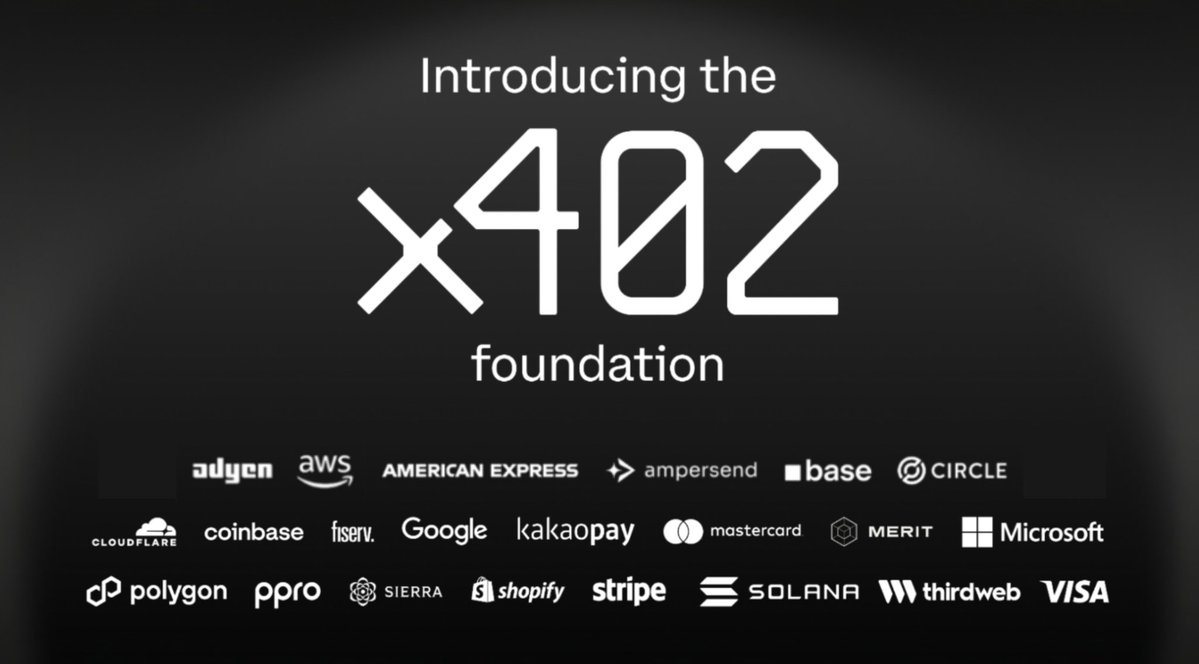
When that many incumbents commit to one design space, the rails get built whether or not the killer use case arrives on schedule. Heavy backing is not a guarantee, because the metaverse and 3D television both drew enormous coordinated investment and never found a use case, but it does mean the infrastructure will be cheap and ready the moment a use case appears.
Two candidates stand out. The first is content gating, where the open web puts a price on access for AI, which we will treat in depth in a separate paper. The second is discoverability and orchestration, where an agent finds and composes endpoints it did not previously know existed. That second case is the through-line of this piece. The underlying primitive of x402 is discoverability and autonomous orchestration of open data. For the provider that wants to be found and for the agent that can evaluate options better than a human can. An agent can index across hundreds or thousands of services, test them, and keep the ones that produce the best result, whether it assembles them ad hoc or reaches for a niche go-to-market surface like Stripe's startup marketplace or Deepline. Those marketplaces are not x402 themselves. They are the same primitive in a different form, aggregated data and services an agent can call and spin up with ease. The limit today is the agent's ability to run that discovery on its own, and that is exactly the gap the goal-based shift is closing, where we give an agent a goal instead of a script and let it find the path.
Closing Thoughts
We have written extensively on agent protocols including: HTTP 402: How Machines Move Money is the technical foundation. It explains why HTTP 402 matters, how x402 and MPP work, and why agents need payment flows that match how they consume resources. That piece answers the infrastructure question of how machines pay for web resources at runtime.
Right now, for agents to be able to operate autonomously, they need and require the ability to discover tools and context on the open internet, and to do so requires an open standard.
References
Cloudflare. (2026). x402: pay-per-crawl and agent payments. https://blog.cloudflare.com/x402/
Coinbase. (2026, June 15). Coinbase and AWS let publishers accept agents as customers via x402. https://www.coinbase.com/blog/coinbase-and-aws-let-publishers-accept-agents-as-customers-via-x402
Coinbase. (2026). Google and x402 [Developer Platform launch]. https://www.coinbase.com/developer-platform/discover/launches/google_x402
Deepline. (2026). Deepline: go-to-market services for agents. https://deepline.com
Exa. (2025, September 3). Exa raises $85M to build the search engine for AIs. https://exa.ai/blog/announcing-series-b
Google. (2002, February 20). Google introduces new pricing for popular self-service online advertising program. https://googlepress.blogspot.com/2002/02/google-introduces-new-pricing-for.html
Mastercard. (2025, April). Mastercard unveils Agent Pay. https://newsroom.mastercard.com/news/press/2025/april/mastercard-unveils-agent-pay-pioneering-agentic-payments-technology-to-power-commerce-in-the-age-of-ai/
OpenRouter. (2026). OpenRouter: a unified interface for LLMs. https://openrouter.ai
Shoal Research. (2026, May 15). Autonomous Agentic Commerce: Micropayments, AgentCash, x402 & MPP [Video]. X. https://x.com/Shoalresearch/status/2055009805346263249?s=20
Shoal Research. (2026, May 28). HTTP 402: How machines move money [Post]. X. https://x.com/shoalresearch/status/2060074558678262025?s=46
Shoal Research. (2026, June 23). Agents Already Spent $76 Million: Circle's AI Agent stack, x402, stablecoins and the Agentic Economy [Video]. X. https://x.com/Shoalresearch/status/2069519304236892629?s=20
Skift. (n.d.). The oral history of Booking.com's acquisition. https://skift.com/oral-history-of-booking-acquisition/
Stripe. (2026). Agentic commerce. https://stripe.com/use-cases/agentic-commerce
Visa. (2025). Find and buy with AI: Visa unveils new era of commerce. https://investor.visa.com/news/news-details/2025/Find-and-Buy-with-AI-Visa-Unveils-New-Era-of-Commerce/
x402scan. (2026). x402 public transaction and merchant data [Dashboard]. https://www.x402scan.com/