
Dashboards are Dead: The SaaS to AI-Agent CLI Pipeline
The last time the customer changed from a human to a machine it created a $135B industry. The agent-first shift is bigger.
One of the last times the customer changed from a human to a machine, it created a $135 billion industry in the U.S. alone, in just one sector: advertising (IAB/PwC, 2024). The agent-first shift is the same structural transformation, but applied across every industry that runs on software. The scale will be orders of magnitude larger, and most people have never heard of the companies that captured that value.
"In 2024, programmatic advertising revenue reached $134.8 billion, marking an 18.0% increase from 2023."
The Core Primitive
AI has promised so many things, and it's becoming clear that AI has huge benefits in orchestrating information and actions. At the root level, the primitive that AI has solved is collapsing the cost of cognition, the way the internet collapsed the cost of communication. Scripts can execute tasks, but AI can reason through them, making decisions where previously you needed a human intermediary exercising judgment. When cognition becomes nearly free, the entire coordination layer to orchestrate cognition becomes the centerpiece.
SaaS products are moving to agent-first, a SaaS-to-CLI pipeline. What I see happening is that many SaaS products in the future are going to become pipelines into people's personal agent infrastructure. Everyone has their personal agent infrastructure, and a lot of people will cloudy and muddy the space by saying there are thousands of agents being deployed onchain, yada yada. The true agents we see now are people's coding agents, which are a great example of a centralized agent. Coding agents are capturing the market right now because of the technical barrier, but the broader point is that each person has a centralized agent. We are seeing early indications with Claude Cowork (non-technical). That centralized agent, operating semi-autonomously similar to something like a Clawdbot (@openclaw), will be piped into all these different applications. So if you're a builder, you essentially need to be able to support the rails into everyone's orchestration agent. By having those orchestration agent rails, the business model then becomes tools, data, intelligence, all these different services, serviceable via products like MCP/CLI and x402/MPP through these personalized orchestration agents.
The savvy teams are understanding this completely. We've seen numerous cases now of protocols like Uniswap, or even web2 companies like Ramp, creating the pipelines for agent-first consumption.
It could be the case that this is essentially the metaphorical death of the dashboard/interface. The dashboard gets removed from the equation, or rather, it becomes less of a visualization layer, because you subscribe to these services and your agent makes the visualizations of the important information. You can crosscut the information in ways that your agent can surface. A dashboard really just serves as discovery, because you don't need to make incremental analysis inside a SaaS product's dashboard. The agent, with context, can monitor for specific triggers, signals, and so on. Instead of you reasoning over your CRM, customer service pipeline, product and project management ticketing, you have a centralized personal authority that makes these decisions.
In March 2026 alone, the pace of agent-first adoption accelerated dramatically across every layer of the stack in the crypto ecosystem:
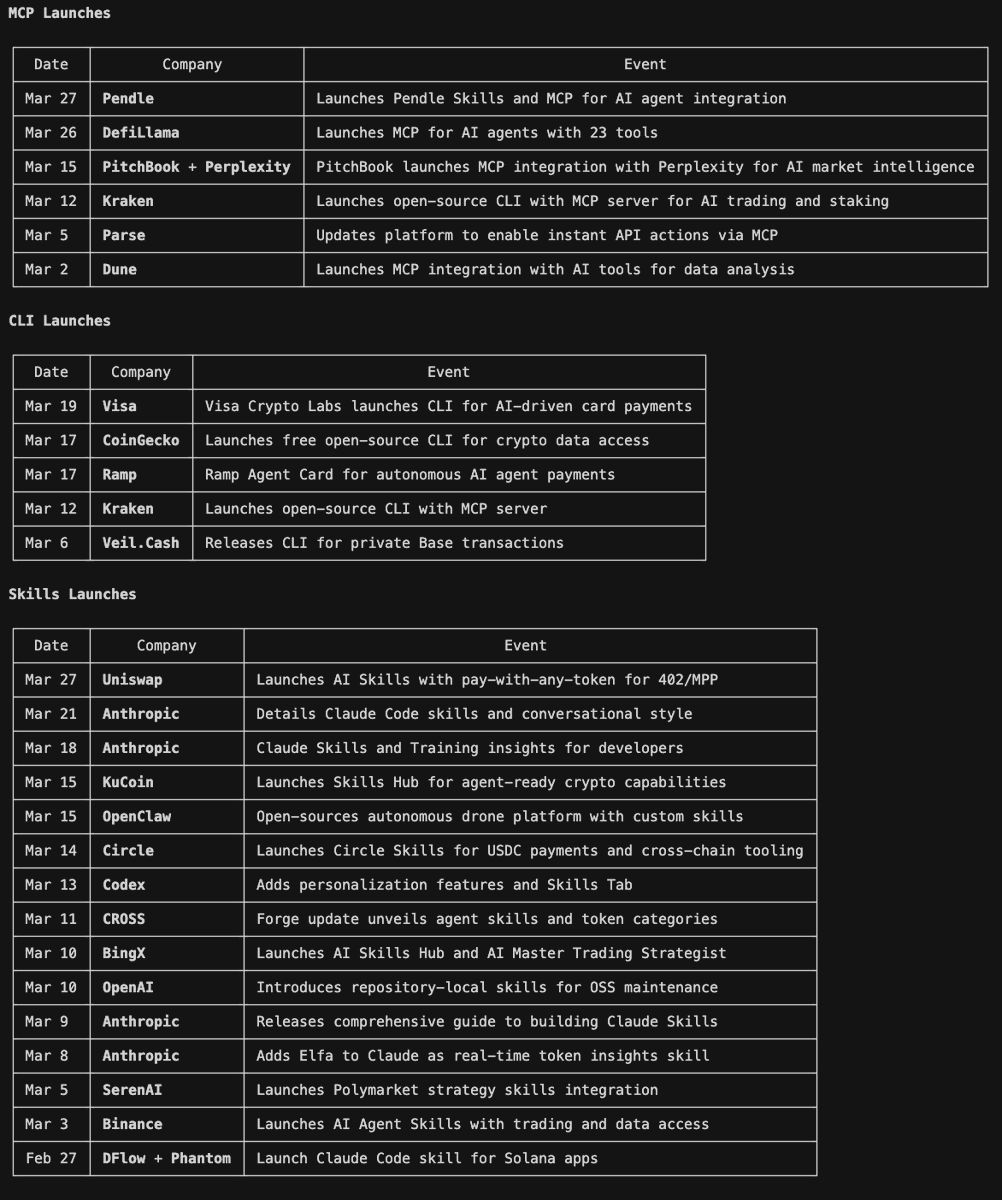
We're seeing that applications like Claude Code, Codex, and Anthropic's Claude Cowork are the early versions of this, and for founders and builders, the interface is the CLI. We're building towards a world where the agent can make micropayments with something like x402 or MPP, and these micropayments for services can scale literally with usage. So not only is there a whole new layer of information consumption (which the data industry is very used to when it comes to APIs and such) but the business models because of agents are also changing. Essentially, the customer is changing from an individual to an agent, and because the user is changing from a person to an agent, the tools, abilities, and structure of consumption all change.
What This Means for Builders
For builders, this is an indication that you need to be comfortable working on your orchestration system. Your tools and everything should pipe into your workspace. For instance, I currently use CRM and product management tools like Linear, and these products can pipe right into my coding agent. I can process an assigned ticket or move business statuses all within a tool like Claude Code. So as builders are building, the era is turning into building things for agents, even if it's web2 SaaS, but especially this is relevant for serving small and medium-sized businesses, where the teams have more flexibility. You don't need approvals to integrate tools. This will be more difficult for enterprise, but for scrappy early-stage companies and founders, teams will likely have highly optimized orchestration stacks that pipe in all of these different business management, sales, and product development tools.
The Trust Monolith Problem
Now what's interesting is that the trust layer now exists and sits within your agent. Your agent becomes the liaison on behalf of your business, and the question is how much trust are people willing to put into these agents? By putting the trust into the agent, although the agent might not be malicious, the structure of knowledge processing and interpretation is shaped by the agent itself. An example might be someone follows up with a message that has sarcasm baked into the context, or you met this person in person. These nuances can be missed by an LLM due to limitations of the technology. That's a clear-cut example, another is that not all people think the same, and you could end up with this monolith of decision-making, a monolith of how businesses are run, created, and operated. So it becomes hyper-important to have agents handle production and orchestration between tools, but still retain the edge methodology and taste of the operator.
In a world where interfaces are diminishing, what actually becomes defensible? Is it the data? Is it the quality of the tool's output? Agents are consuming different types of tools: intelligence, information retrieval like search, API keys for other LLMs, specialized LLMs, structured data products and frameworks like CRMs. In a time like this, distribution becomes the moat. Distribution, trust, regulatory capture. Integration with the CLI and coding agents is becoming a new product distribution rail, a new way of serving products, a new customer, and that new customer has different requirements and different demands.
A Historical Parallel: Programmatic Advertising
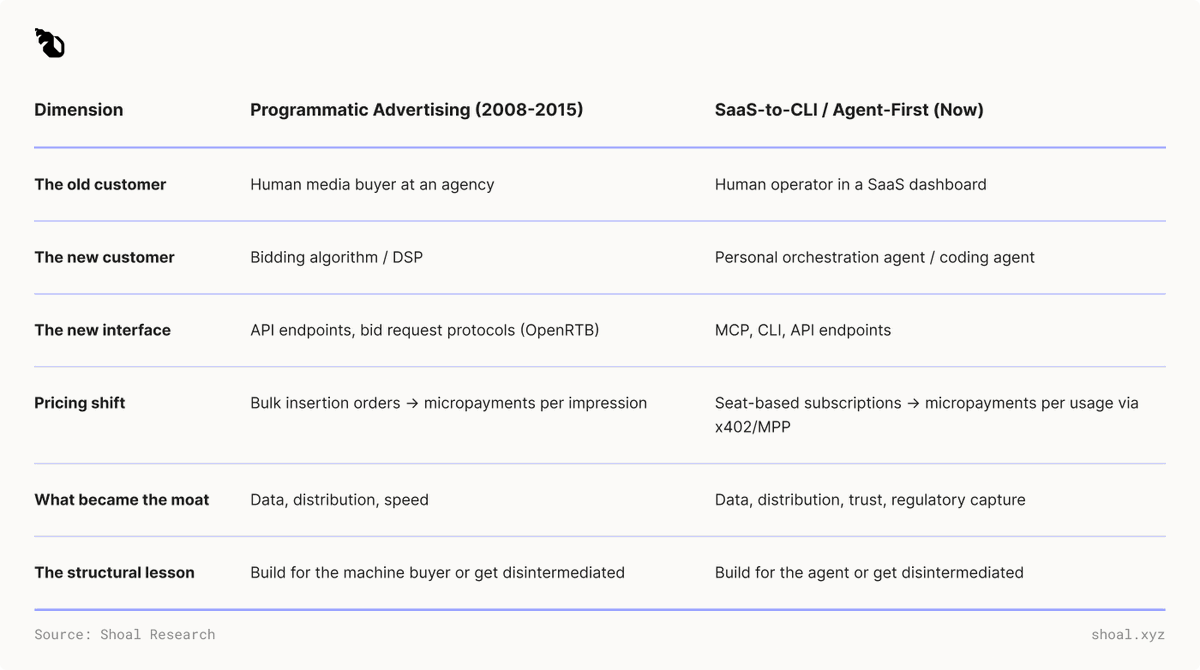
This shift has a direct historical precedent. In the late 2000s, digital advertising underwent the exact same structural transformation. Before programmatic, advertising was a human-to-human business. A media buyer at an agency would call a sales rep at a publisher, negotiate rates, sign insertion orders, and manually place ad campaigns. The interface was literally a person: relationships, phone calls, dinners, RFPs. The publisher's value was bundled: audience, placement, creative context, and reporting all came through the same dashboard and the same salesperson.
Then the customer changed. The breakthrough came from Brian O'Kelley at Right Media, who developed the concept of real-time bidding around 2007. Instead of pre-buying blocks of impressions, RTB allowed advertisers to bid on individual ad impressions in real time as users loaded web pages. It was the equivalent of a stock exchange firing off trades in milliseconds. Google recognized the magnitude of this shift early, acquiring DoubleClick in 2007 for $3.1 billion in cash, which became the backbone of its programmatic empire. The OpenRTB protocol, formalized by the IAB Tech Lab in 2010, became the standardized language for machine-to-machine ad transactions, the same role MCP is beginning to play for agent-to-service communication today.
The algorithm needed an API, structured bid requests, impression-level data, and the ability to transact in microseconds at fractions of a cent. Not a dashboard or relationship, and didn't care about the publisher's brand. The entire industry restructured around serving this new machine customer.
The agent-first shift applies the same structural transformation to every industry that runs on software: financial services, healthcare, logistics, legal, commerce, project management, and beyond. The addressable market is orders of magnitude larger than what programmatic captured in ads alone.
The parallel to what's happening now with SaaS and agents is nearly exact:
The Downside: What Happens When You Remove the Human
The programmatic shift also came with significant downsides that builders in the agent-first era should study carefully. When you remove the human from the transaction, you lose judgment. In programmatic advertising, this manifested as a massive brand safety crisis: algorithms couldn't judge context, and major brands found their ads running next to extremist content, fake news, and harmful material. JP Morgan Chase discovered its ads on conspiracy sites. The automated system optimized for reach and cost, not for context or reputation. Ad fraud became an enormous problem as well. According to industry estimates, global losses to ad fraud exceeded $35 billion annually, and one study found that just 36 cents of every dollar spent on programmatic advertising actually reached the consumer. Fraudsters built fake websites, deployed bot farms to simulate clicks, and exploited the automated nature of the system to siphon billions from advertisers who had no visibility into where their money was going.
The parallel to agent-first SaaS is direct and should serve as a warning. When your agent becomes the liaison for your business, it inherits the same blindness. It can't judge whether a vendor is trustworthy based on a handshake. It can't read the room in a negotiation. It will optimize for whatever signal it's given, and if the signal is wrong, it will optimize confidently in the wrong direction. Just as programmatic created an entire ecosystem of ad fraud because the machine buyer couldn't distinguish real inventory from fake, agent-first commerce will create new categories of fraud, where services game agent decision-making the way fake publishers gamed bidding algorithms. The lesson from programmatic is clear: when you remove the human from the loop, you gain speed and scale but lose context and judgment. The companies that built verification layers, brand safety tools, and fraud detection on top of the programmatic infrastructure captured enormous value by solving the problems the shift created. The same opportunity exists now.
Whoever builds the trust, verification, and quality layers for agent-to-service transactions will be solving the inevitable problems of the agent-first era.